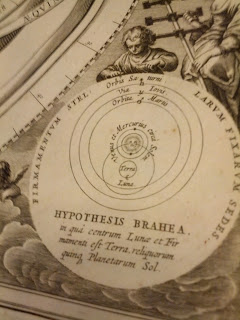
“Google Maps uses the Mercator projection,” said Gregor Rothfuss, 35, the technical lead for Google Maps user interface in Chelsea. “He came up with the formula.” Mercator’s projection tackles the challenge of depicting a three-dimensional world in 2 dimensions, Rothfuss explained. “If you imagine wrapping a newspaper around a globe, you can’t do that neatly,” said Rothfuss, who attended the opening night reception on Monday. But Mercator was able to develop a mathematical formula that helped ease the translation of globe to map. Mercator’s projection is widely used, Rothfuss said, but like all map projections, it isn’t perfect. Mercator’s method tends to exaggerate the size of large geographic areas, like continents or the north and south poles, Rothfuss said. But it causes very little distortion when used for areas on a more human scale, like plotting distances within a few miles, Rothfuss explained. “That’s why it’s still so heavily used,” he added. “Overall, I think Mercator would be proud to see that, even today, we use his stuff and that every one of us is a mapmaker.”
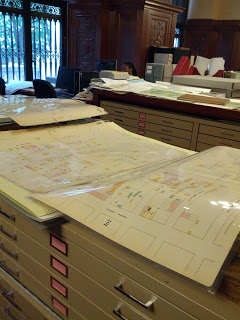
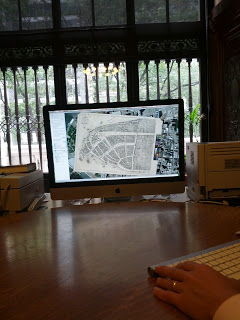
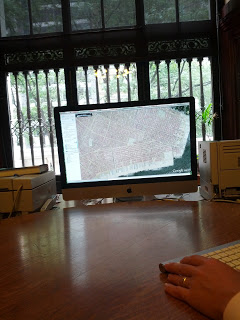
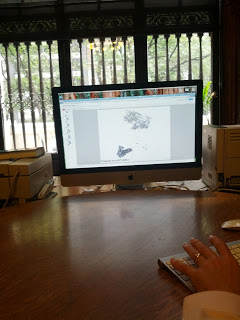
After speaking at an event at the NYPL in March, i want back to visit the map department. the work the nypl is doing to digitize and geocode historical maps is outstanding.
when they are done, you will be able to pull up maps like: show me all the bakers operating in manhattan in 1790. that should be instructive.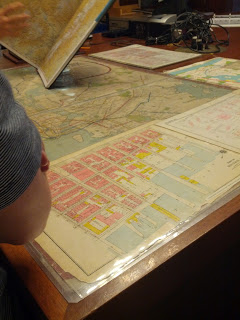







 Gregor J. Rothfuss