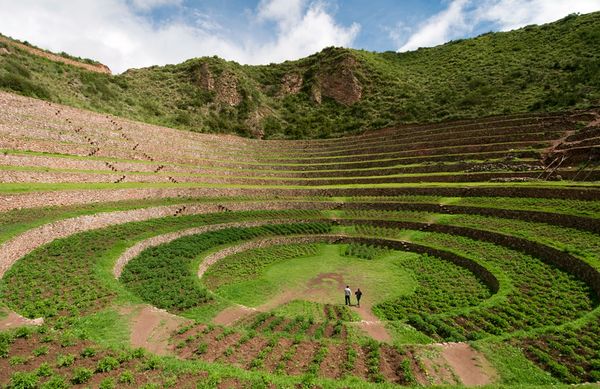
Large-scale agricultural experimentation by the incas, and how similar designs could be used to affect climate on a continental scale. There are some theories that this is exactly what happened in the amazon basin:
“Anthropologists now believe that the majority of the Amazon rain forest was managed by humans. There are many fruit and nut bearing trees in the Amazon, and this was probably due to human interference. They also used a unique form of burning in the Amazon, where they would stop the fields from completely burning so that there would be charcoal. Turns out the active carbon in charcoal bonds to organic elements and makes the soil as good or probably better than using fertilizer.” (from the excellent 1491 by Charles Mann)
The amazon basin has been terraformed on a large scale as far back as 2500 BP, supporting a population of 8M by the time the spaniards showed up in 1492. After that, it of course crashed.
2020-04-11: The large scale cultivation goes back much further.
We show that, starting at around 10 ka BP, inhabitants of this region began to create a landscape that ultimately comprised 4700 artificial forest islands within a treeless, seasonally flooded savannah. Our results confirm that humans have markedly altered the landscape ever since their arrival in Amazonia.
2022-06-02: Amazonian cities
Starting 1.5 ka BP, ancient Amazonians built and lived in densely populated centers, featuring 22m earthen pyramids and encircled by kilometres of elevated roadways. 2 of the urban centers each covered an area of more than 100 hectares — 3x the size of Vatican City. The lidar images revealed walled compounds with broad terraces rising 6m above ground. On one end of the terraces stood conical pyramids made of earth. People likely lived in the areas around the terraces and travelled along the causeways connecting the sites to one another. Lidar images found reservoirs in the settlements, perhaps indicating that this part of the world wasn’t always wet — an environmental shift that might have driven people away. But then again, steady pollen records reveal that maize was grown in the area continuously for 1000s of years, indicating sustainable agricultural practices.

 Gregor J. Rothfuss