So, take it from well-informed sources that Sondre Lerche will be big. One of his songs played at the sushi place last night, which was most amazing. and, he is only 21. Go Sondre!!
Month: November 2003
augmented neighborhoods
Public Authoring in the Wireless City
Urban Tapestries is a framework for understanding the social, cultural, economic and political implications of pervasive location-based mobile and wireless systems.
this reminds me of jo walsh. like slapping a commercial label on her pioneering work. overlays to augment physical spaces, yummy!!
KAYWA in the news
my friend martin hitz wrote a nice article about moblogging for nzz. it mentions KAYWA.
the Swiss start-up Kaywa make it possible to post pictures and short texts via MMS or GPRS email directly from your mobile phone on the Internet. While conventional weblogs have meanwhile blossomed from a simple diary to a format to be taken seriously, also for serious content and are now also used by politicians, stars and journalists, the mobloggers are starting again at field one. No event banal enough, no holiday experience too personal and no picture too blurry not to appear in a moblog. More or less sharp photos of conferences, family celebrations and techno parties are published there
Learning from the masters
i just got back from las vegas, via a (less than satisfactory) detour through NYC. apachecon 2003 was a great time to learn, meet and geek out. i haven’t been to a conference (besides our own) in a while where i felt so at home and had such a vibrant network right from the start.
now, the real challenge strikes me as enabling this level of interaction for the interested conference goer who is not fortunate enough to be associated with apache. clearly, that is almost unattainable, but some measures we tried at OSCOM 3 may be helpful.
attendees never do the sensible thing before the conference, it seems, and most calls for a good self-preparation (in the interest of a better conference experience) are not widely heard.
underwhelmed
who invited chris pirillo to keynote at apachecon? the first 21 minutes, he talked about himself, and finally reached his premise after 37 minutes even though it was immediately apparent. give me a break.
UPDATE
heh, i should have worded this more carefully, and not blog immediately.. i very much agreed with the premise of the talk, it is the delivery (given the techie audience) that made me unhappy. no hard feelings, chris. coffee sounds good.
UPDATE 2
in the meantime, we talked, and i directed chris to some cool RSS applications. curiously, our little thingie got covered in the seattle pi.
Magnolia

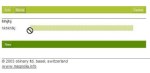
a swiss company released a new CMS yesterday: Magnolia is the first open-source content-management-system (CMS) which adheres to the upcoming standard of Java content repositories.
a first look did not impress me that much, the exposed functionality is quite spartan at this point. on the other hand, the repository abstraction is something to look into. also, the ability to move content around with the mouse (see screen shot 2) is neat.
Steb Sly and John Weir
Steb Sly emailed me yesterday and alerted me to some of his tracks. I especially like his live set (40min). Meanwhile, my friend John Weir was spinning in San Francisco yesterday, and I hope the recording will be online soon.
Hyperfluency
While extinction has been the fate of many creative entrepreneurs of the late 60s and 70s and 80s, why has the INTERCONTINENTAL FOREIGN LANGUAGE PROGRAM – whose symbol is the living Phoenix bird, so familiar to people on the street through millions of language fliers over the years – flourished? In part, the answer lies in the way its founder, director, and principal instructor, Lee Riethmiller, honed his fluency in the 26 languages he currently speaks. Riethmiller’s unique septalingual course (where students learn to speak 7 languages simultaneously) drew interest from The Christian Science Monitor, The Brookline Tab, US Magazine, CBS Television, and National Public Radio.
carl made me aware of this guy. i would love to go to a class, just to see how the system works. and picking up 7 new languages, why not 🙂 my list would be:
- chinese (mandarin)
- spanish
- japanese
- portuguese
- sanskrit
- russian
- arabic
we’ll get perfect translation via AI before we get this sort of hyperfluency (16 languages!) from a large part of society.
12 years on, Fedorenko is confident of certain findings. All her subjects show less brain activity when working in their mother tongue; they don’t have to sweat it. As the language in the tests grows more challenging, it elicits more neural activity, until it becomes gibberish, at which point it elicits less—the brain seems to give up, quite sensibly, when a task is futile. Hyperpolyglots, too, work harder in an unfamiliar tongue. But their “harder” is relaxed compared with the efforts of average people. Their advantage seems to be not capacity but efficiency. No matter how difficult the task, they use a smaller area of their brain in processing language—less tissue, less energy.
All Fedorenko’s guinea pigs, including me, also took a daunting nonverbal memory test: squares on a grid flash on and off as you frantically try to recall their location. This trial engages a neural network separate from the language cortex—the executive-function system. “Its role is to support general fluid intelligence”. What kind of boost might it give to, say, a language prodigy? “People claim that language learning makes you smarter,” she replied. “Sadly, we don’t have evidence for it. But, if you play an unfamiliar language to ‘normal’ people, their executive-function systems don’t show much response. Those of polyglots do. Perhaps they’re striving to grasp a linguistic signal.” Or perhaps that’s where their genie resides.
Barring an infusion of Valproate, most of us will never acquire Rojas-Berscia’s 28 languages.
no soliciting
I am writing to find out something from you. I have my sister who lives in Boston right now, and having a really TOUGH time finding employment. What are the opportunities like? I used to live in Boston, actually, I attended Suffolk, and I can’t believe that she can’t find anything. How about your company, do you think you can work some magic?
i’m getting solicitations from strangers on ryze now.
1-way communication
i had a demo with webx yesterday to an audience that was 5000 km away. it was quite weird to talk to an audience i could not see. not being able to parse facial expressions meant i had no clue whether my demo was going anywhere.
 Gregor J. Rothfuss