here are the notes from the panel i was on at seybold for some stupid reason, they are keeping the slides to themselves behind a password:
why i blog?
– first note taking
– short attention span
– exotic hobby, no one i knew personally was doing it
– more and more interaction with others
– serendipity is my big thing now
– got more and more interested in blog infrastructure
– not what is obvious (posts), but what is harder to see: interactions, patterns,
– immediacy is important
– “i was there”
– discovery of context, very local
– led to more mobile uses of blog.
– a picture has higher emotional quality
– who cares about pictures once you are home
my tool
– kaywa: focusing on the swiss market where picture phones and mobile us e is big. not too many weblogs yet
– we are php guys with a strong interest in xml
– we were not happy with the usability of existing tools, although mt comes close
– we want to make it easy to publish from your mobile
– pictures integrated
– involved with internet art
– very picture-driven -> perfect use of moblog
– lower barrier to entry
– strikes me as a very consumer thing, taking pictures & uploading them.
– interest from realtors, doctors
Month: September 2003
textamerica
i just met janet leigh, CEO of textamerica, another contender in the moblog industry. can’t find her moblog yet, but i will keep looking.
Interactive politics
funnily, i’m knee-deep in politics on this trip. between helping my friend henri who is in charge of IT for kucinich and advising chris who is running for office in palo alto, i’m getting a good idea of how the campaigning works around here. tobias mentions swiss politicians and weblogs. i’m not very hopeful that they will get a clue any time soon, but there are some political weblogs in switzerland. of course they only pay lip service. i mean, what’s up with not updating since december 2002?
marrying wikis and SCM
when i met gstein last night he made me aware of subwiki. subwiki is a wiki built on top of subversion. this has several advantages over other wikis:
- Each edit is a real change set
- you can access the wiki over WebDAV
- the wiki handles attachments seamlessly
if subwiki delivers on its promise, it will be a very powerful tool for document management, km and collaboration.
dinner with gavin nicol
michael and myself were treated to awesome sushi by gavin t. nicol who turns out to be a very likable guy with an incredible depth of experience with XML technologies. He coauthored most of the specs i use on a daily basis. He is eager to work together with us, which i’m very much looking forward to. thanks again gavin.
Bomb threat
We have to evacuate. Bomb threat. go figure… CONNECTION RESET BY PEER
Tim Bray had this amusing comment
We were going off to the hotel to hang out in the bar, but Gregor Rothfuss wanted to mobile-blog this.
Blogger dinner
I’m having dinner tonight 18:00 at Max Diner, at Folsom / 3rd in SOMA. Confirmed so far:
If you want to join, feel free.
Phil has a nice writeup.
Plague
It was about the beginning of September, 1664, that I, among the rest of my neighbors, heard in ordinary discourse that the plague was returned again in Holland; for it had been very violent there, and particularly at Amsterdam and Rotterdam, in the year 1663, whither, they say, it was brought, some said from Italy, others from the Levant, among some goods which were brought home by their Turkey fleet; others said it was brought from Candia; others from Cyprus. It mattered not from whence it came; but all agreed it was come into Holland again.
I just finished Daniel Defoe’s a journal of the plague year.
2014-09-30: this is an awesome poster visualizing the plague, walking you through how real science is done, in an entertaining and informative way.

2015-10-06: Plague is one of the most virulent pathogens.
the acquisition of a single gene named pla gave Y. pestis the ability to cause pneumonia, causing a form of plague so lethal that it kills essentially all of those infected who don’t receive antibiotics. In addition, it is also among the most infectious bacteria known. “Yersinia pestis is a pretty kick-ass pathogen. A single bacterium can cause disease in mice. It’s hard to get much more virulent than that.”
2021-03-30: Pushing the Black Death origin back.
Monica Green published a landmark article, The 4 Black Deaths, in the American Historical Review, that rewrites our narrative of this brutal and transformative pandemic. In it, she identifies a “big bang” that created 4 distinct genetic lineages that spread separately throughout the world and finds concrete evidence that the plague was already spreading from China to central Asia in the 1200s. This discovery pushes the origins of the Black Death back by over 100 years, meaning that the first wave of the plague was not a decades-long explosion of horror, but a disease that crept across the continents for over 100 years until it reached a crisis point.
2022-02-16: Black Death mortality rates varied widely.
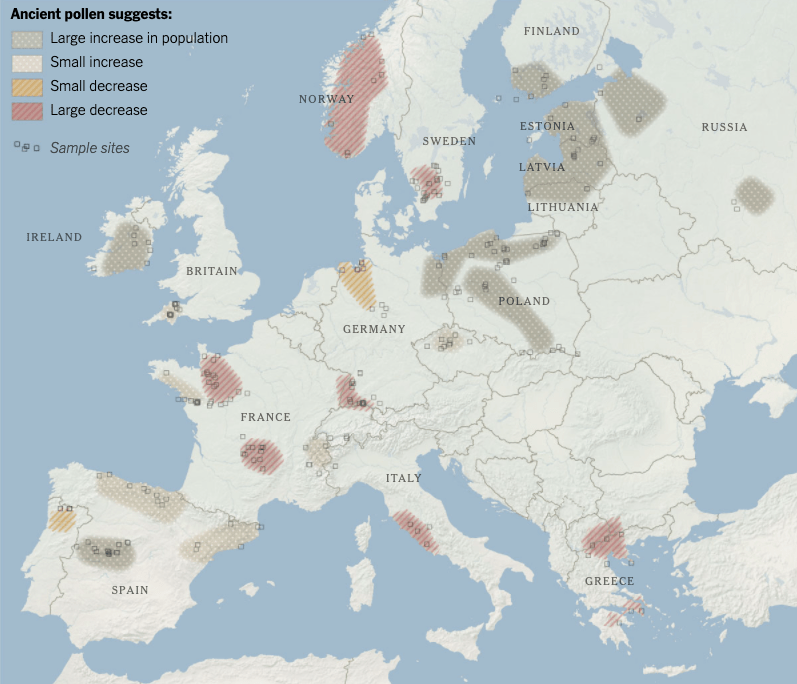
“The data is sufficiently widespread and numerous to make it likely that the Black Death swept away 65% of Europe’s population”. But those figures, based on historical documents from the time, greatly overestimate the true toll of the plague. By analyzing ancient deposits of pollen as markers of agricultural activity, researchers found that the Black Death caused a patchwork of destruction. Some regions of Europe did indeed suffer devastating losses, but other regions held stable, and some even boomed. It’s possible that the ecology of rats and fleas that spread the bacteria was different from country to country. The ships that brought Yersinia to Europe may have come to some ports at a bad time of the year for spreading the plague, and to others at a better time.
2022-08-12: The plague may have had a role in the collapse of Egypt’s Old Kingdom and the Akkadian Empire in Mesopotamia
During the late 3rd millennium BCE, the Eastern Mediterranean and Near East witnessed societal changes in many regions, which are usually explained with a combination of social and climatic factors. However, recent archaeogenetic research forces us to rethink models regarding the role of infectious diseases in past societal trajectories. The plague bacterium Yersinia pestis, which was involved in some of the most destructive historical pandemics, circulated across Eurasia at least from the onset of the 3rd millennium BCE but the challenging preservation of ancient DNA in warmer climates has restricted the identification of Y. pestis from this period to temperate climatic regions. As such, evidence from culturally prominent regions such as the Eastern Mediterranean is currently lacking. Here, we present genetic evidence for the presence of Y. pestis and Salmonella enterica, the causative agent of typhoid/enteric fever, from this period of transformation in Crete, detected at the cave site Hagios Charalambos. We reconstructed 1 Y. pestis genome that forms part of a now-extinct lineage of Y. pestis strains from the Late Neolithic and Bronze Age that were likely not yet adapted for transmission via fleas. Furthermore, we reconstructed 2 ancient S. enterica genomes from the Para C lineage, which cluster with contemporary strains that were likely not yet fully host adapted to humans. The occurrence of these 2 virulent pathogens at the end of the Early Minoan period in Crete emphasizes the necessity to re-introduce infectious diseases as an additional factor possibly contributing to the transformation of early complex societies in the Aegean and beyond.
Quake
we just had a 3.9 earthquake.
happy birthday monorom
late, i know..
 Gregor J. Rothfuss