notes on .net and how open source may counter the threat, some stats and great food. we hurried to the conference area after a much too early rise. it was on the way to the conference that we realized for the first time how huge teched is.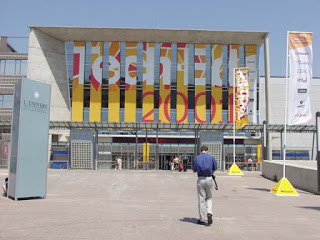
the main room was just gigantic. 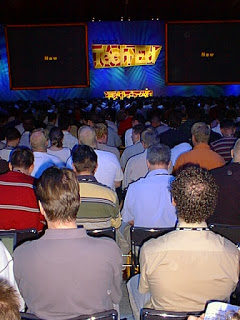
we were greeted by queens barcelona anthem followed by some dull marketing fluff. among reams of uninteresting tidbits we learned that there were some 9000 attending teched. after a while anders hejlsberg entered the stage to give the first keynote. considered by some to be one of the best programmers, his performance left a lot to be desired. of course, he had to remain on the surface, this being the keynote he had no chance to demonstrate some of his considerable talents as a language / systems architect. he was quite successful to give a glimpse of the .net framework and its far-reaching impact, however. all of the days sessions centered around .net. the point that microsoft believes in open standards was driven home many times, with some credible demonstrations like microsoft’s early involvement in xml standardization and its increasing reliance on established standards like kerberos, ldap, dynamic dns, wbem (web based enterprise management), xpath, xslt, http (the list goes on) over the course of these presentations it became very clear that microsoft has unleashed something much larger than it can ever hope to handle like it has in the past when it introduced the concept of web services. web services have all the ingredients of a disruptive technology. they place simplicity where complexity and opaque systems have reigned for so long.
their complete reliance on xml for all aspects has brought them some criticism from some quarters that they are not being efficient and that xml adds nothing that was not there before. i was wondering along these lines as well. however when i saw how the concept of web services has evolved in one year i started to notice similarities to the classic and incredibly successful osi model. web services start where osi ends, but they share the concept of piling independent services on top of each other. this has been a very powerful architecture in networking systems, especially tcp/ip. since xml is such a simple representation of data it has been very easy to extend web services with additional layers and make them increasingly powerful. i believe that the benefits from a large scale adoption of xml will be reaped with ever more layers stacked on each other, with ever increasing power.
although web services are an active area for the w3c, it remains doubtful how the industry will counter microsoft’s .net juggernaut. declaring support for soap, as ibm, sun, oracle and others have done, is not going to cut it. what is needed is a credible architecture that can compete feature by feature with .net. although all the components like apache (web server), soap for apache, jabber (xml messaging), kdevelop (ide), postgresql (database), ldap (directory) exist in the open source community, they are not part of an overall architecture. it would be a major undertaking to get the developers of the respective components to talk to each other and agree on common interfaces. the old unix argument about never setting policy looks quite silly when you realize what productivity gains microsoft will be leveraging with their .net platform.
it also became quite evident that we have seen nothing yet in terms of the web services architecture. many key pieces are missing, like meta data to enable the retrieval and processing of semantics from
data (to support agent technology for instance), the questions of payment for web services and global, fine-grained security matrices (who has access to which of my data). web services are loosely coupled
but they have no mechanism to guard against api changes or to facilitate negotiations on usage terms for web services.
besides all these lofty ideas we came back to reality quickly when we saw the enormous amount of logistics that went into this conference. details like having a dining hall for 9000 people
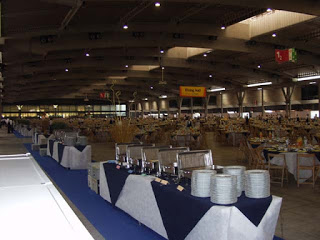 or being so well organized that leaving my camera in the computer area was not a complete disaster (i struck it lucky when i got it back from the lost & found counter) made a big impression on me. the all you can eat buffets every few meters had their influence as well..
i learned a few interesting details about eai (enterprise application integration) an area where bea systems has been strong and microsoft made their debut with their biztalk server. for instance most people that believe that they need synchronous interfaces (ie immediate access to results) actually don’t.
you can fool these people with clever tricks like pretending to be synchronous on the front end via http redirects while your backend interface is in fact asynchronous. the graveyard session for the day was actually quite funny even though the main speaker had to boast about his accomplishments all the time. they shared many anecdotes like being used as a spam relay during scalability testing, their isp wrongly throttling their bandwidth on the incoming mail connection to 70 kps for 500 concurrent users 🙂 they made up for that with their end to end ipsec deployment (would have been too lovely to sniff passwords in a lan with 6000 mobile ethernet clients..) and replicating several databases in real time to london. after this session we were driven to a nice location just opposite our hotel for the swiss country dinner. it was basically one of the nicest places i have been to in quite some time. great job microsoft.
 Gregor J. Rothfuss